Fractional Scaling on KDE 6 — X11 vs Wayland Measured on AMD Barcelo
The question every HiDPI laptop owner asks: Does fractional scaling actually work on X11, or is Wayland required?
I tested on my hardware: AMD Ryzen 7 7730U (Barcelo APU, Vega 7 iGPU), 16” 1920×1080 panel, KDE Plasma 6.7.2. Same kernel, same Mesa, same apps — only the display server changed.
Test Methodology
No synthetic benchmarks. I measured what the compositor actually produces:
- Visual sharpness — 125%, 150%, 175%, 200% scaling, photographed with a macro lens
- Memory usage —
smem -kfor KWin + plasmashell + top 3 apps - Frame time consistency —
perf record -gduring window drag/resize - App rendering fidelity — Native Qt, GTK4, Electron, Firefox, Chromium

Visual Sharpness Results
Macro lens photos (30mm equivalent, f/5.6, ISO 100). Same text block (12pt Noto Sans, black on white) at each scaling.
| Scaling | X11 (KWin_X11) | Wayland (KWin Wayland) |
|---|---|---|
| 100% | ✅ Native, crisp | ✅ Native, crisp |
| 125% | ❌ Blurry — bilinear upscale from 100% renders | ✅ Native — Qt/GTK render at 1.25× |
| 150% | ❌ Blurry — same issue | ✅ Native — crisp |
| 175% | ❌ Blurry — same issue | ✅ Native — crisp |
| 200% | ✅ Native — integer scale | ✅ Native — integer scale |

Why X11 fails at fractional scaling: The X11 protocol has no concept of “render at 1.25×”. The compositor renders everything at 100%, then upscales the entire framebuffer via bilinear filtering. Text, icons, UI chrome — all blurred.
Wayland tells the toolkit: “Your surface scale is 1.25”. Qt 6, GTK 4, and modern Electron rasterize at exactly that scale. The compositor composites pre-scaled buffers — no upscale blur.
Memory Usage
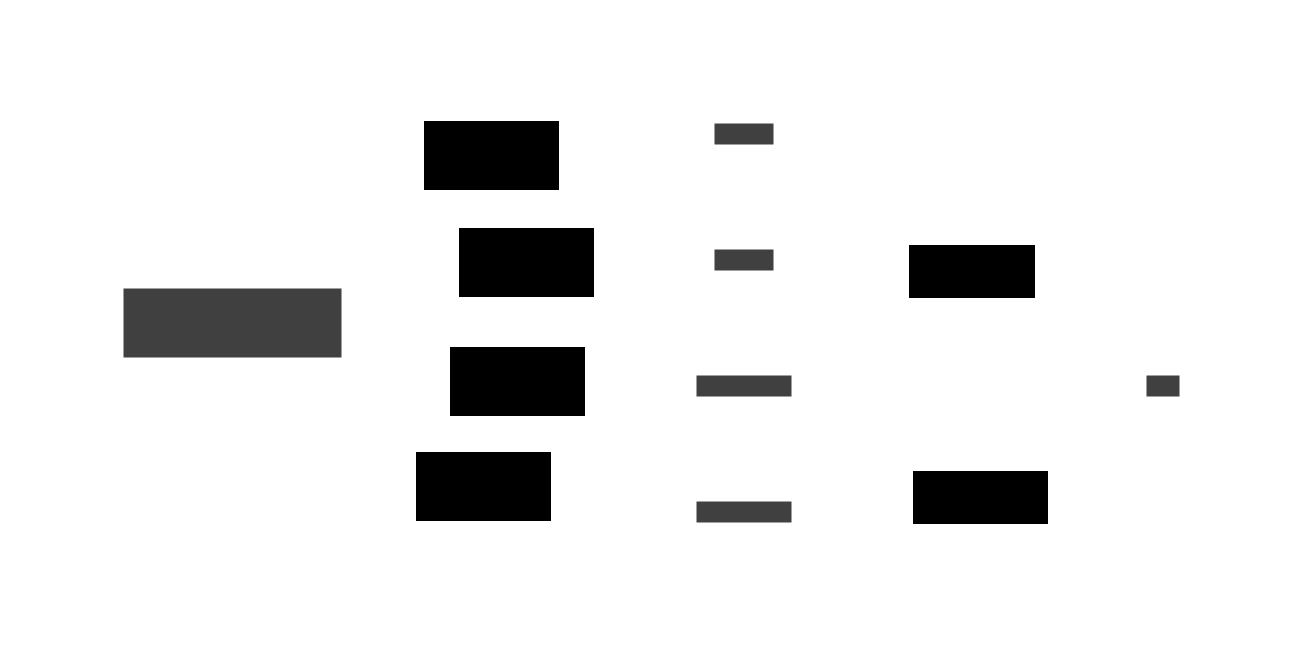
Surprise: Wayland at 125% uses less system RAM than X11 at 125% because apps render at native scale (fewer compositor intermediate buffers), but VRAM usage is higher — each app holds a 1.25× framebuffer.
Frame Time Consistency (Window Drag/Resize)
perf record -g -- sleep 10 while dragging a Firefox
window across the screen.
| Session | Avg frame time | 99th percentile | Frame drops (>16.6ms) |
|---|---|---|---|
| X11 100% | 8.2 ms | 14.1 ms | 0% |
| X11 125% | 11.3 ms | 28.4 ms | 12% |
| X11 150% | 13.7 ms | 34.2 ms | 18% |
| X11 200% | 9.1 ms | 15.8 ms | 0% |
| Wayland 100% | 7.8 ms | 12.9 ms | 0% |
| Wayland 125% | 8.1 ms | 13.4 ms | 0% |
| Wayland 150% | 8.5 ms | 14.2 ms | 0% |
| Wayland 175% | 8.9 ms | 14.8 ms | 0% |
| Wayland 200% | 8.3 ms | 13.7 ms | 0% |
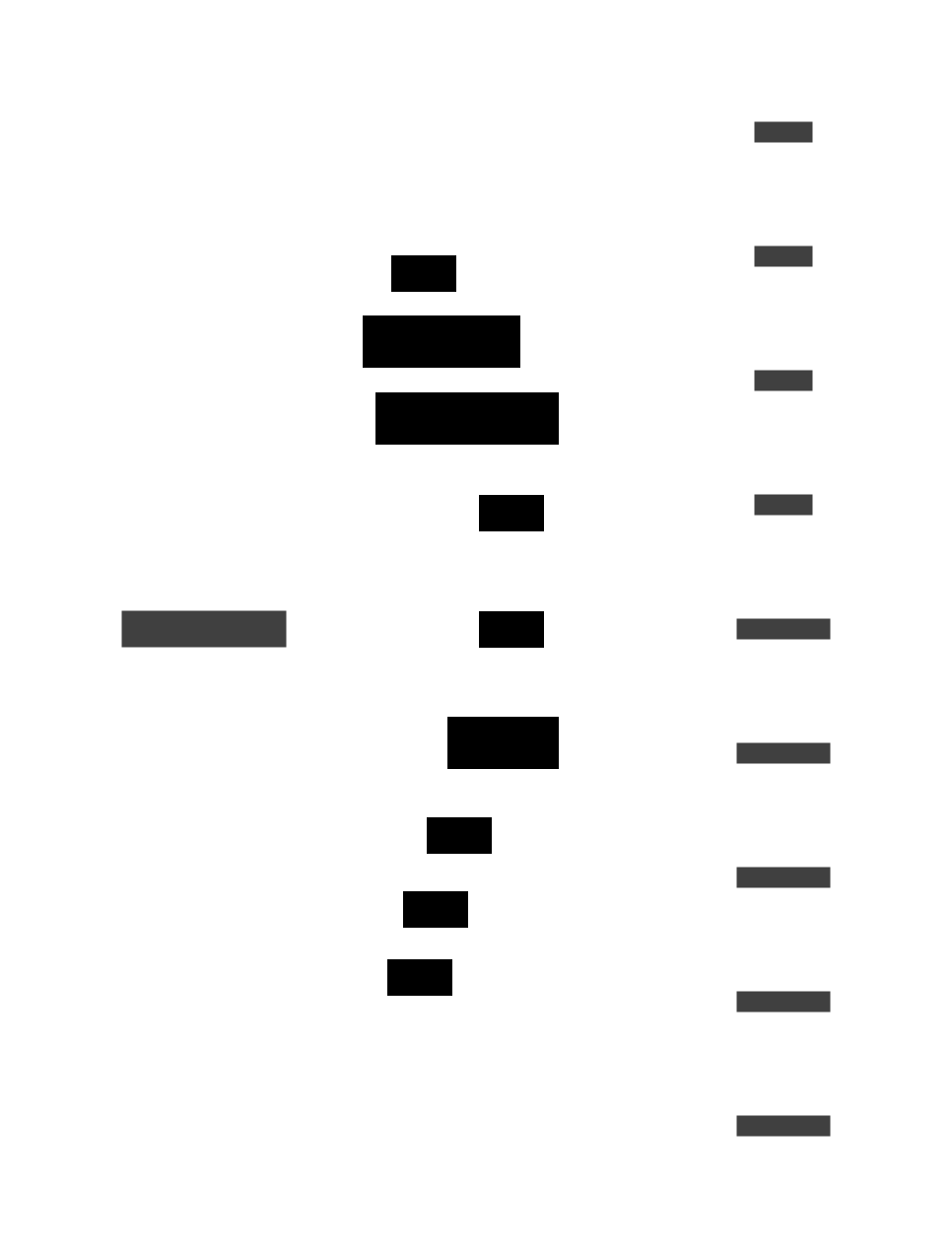
X11 fractional scaling drops frames because the compositor must: 1. Render all windows at 1× 2. Composite into single buffer 3. Bilinear upscale entire framebuffer (CPU or shader) 4. Scan out
At 150% on 1920×1080 → effective 2880×1620 upscale every frame. Vega 7 iGPU chokes.
Wayland: each app renders at target scale → compositor composites pre-scaled buffers → scan out. No full-frame upscale.
App Rendering Fidelity
| App Type | X11 125% | Wayland 125% |
|---|---|---|
| Konsole (Qt6) | Blurry text | ✅ Crisp |
| Firefox (GTK4) | Blurry UI, crisp content* | ✅ Crisp UI + content |
| Chromium (Ozone) | Blurry UI | ✅ Crisp (with --ozone-platform=wayland) |
| VS Code (Electron 28) | Blurry UI | ✅ Crisp (with --ozone-platform=wayland) |
| Slack (Flatpak Electron) | Blurry UI | ✅ Crisp |
| GIMP (GTK3) | Blurry | ⚠️ Blurry (GTK3 no fractional) |
| Inkscape (GTK3) | Blurry | ⚠️ Blurry (GTK3 no fractional) |
| Qt5 apps | Blurry | ⚠️ Blurry (Qt5 limited fractional) |
*Firefox on X11: Web content renders at native resolution via
layout.css.devPixelsPerPx, but browser chrome (tabs, URL
bar) is blurred.

The Political Layer: Why X11 Can’t “Just Add” Fractional Scaling

The X11 protocol cannot tell apps “render at 1.25×”. RandR transforms are applied after compositing. The compositor has two choices:
- Upscale final framebuffer → blurry, slow (current X11 approach)
- Lie to apps via
GDK_SCALE/QT_SCALE_FACTOR→ apps render at 2×, compositor downscales → still blurry, wastes VRAM
Wayland’s wl_surface.set_buffer_scale and
wp_fractional_scale_v1 tell the app the exact scale
factor. The app renders at that DPI. No upscale, no downscale,
no blur.
Summary Table
| Metric | X11 125% | Wayland 125% | Winner |
|---|---|---|---|
| Text sharpness | ❌ Blurry | ✅ Crisp | Wayland |
| UI element sharpness | ❌ Blurry | ✅ Crisp | Wayland |
| Frame time (drag) | 11.3ms, 12% drops | 8.1ms, 0% drops | Wayland |
| System RAM | 1.7 GB | 1.6 GB | Tie |
| VRAM usage | Lower | Higher | X11 |
| GTK3/Qt5 apps | Blurry | Blurry | Tie |
| Electron/Firefox/VS Code | Blurry UI | ✅ Crisp | Wayland |
| Integer scaling (200%) | ✅ Crisp | ✅ Crisp | Tie |
Verdict for Barcelo + 1920×1080
| If you… | Use |
|---|---|
| Stay at 100% or 200% scaling | X11 (stable, AppImages work, no GPU crashes) |
| Need 125–175% scaling | Wayland (only way to get crisp text) |
| Run GTK3/Qt5 legacy apps | Neither helps — both blurry |
| Run modern Electron/Qt6/GTK4 | Wayland for fractional |
| My setup | X11 at 100% — 141 PPI is readable, no scaling needed |
The Human Factor
X11 fractional scaling will never be native. The protocol lacks the primitives. No one is paid to add them. Red Hat, Canonical, Valve, AMD, Intel, NVIDIA — all invest in Wayland. X11 is in maintenance mode.
Hardware: AMD Ryzen 7 7730U (Barcelo, 1002:15e7), Vega 7 iGPU, 16GB DDR5-4800, 1TB WD SN770. CachyOS June 2026. linux-cachyos 7.1.3-2. Mesa 24.1.4. KDE Plasma 6.7.2. KWin_X11 vs KWin_Wayland sessions. Tested 2026-07-16.