A Developer's Guide to Agile & Scrum: Demystifying Assignment 1

Welcome to our Agile classroom! Today, we are going to demystify Agile Project Management and the Scrum Framework.
Whether you are preparing for your formative assessments or trying to understand how to apply Scrum to real-world software engineering, this guide breaks down the core concepts from Assignment 1 into clear, digestible sections with visual diagrams.
1. The Core Philosophy: Agile vs. Waterfall
Traditional project management follows a Waterfall (sequential) approach: requirements are gathered, designs are made, code is written, and testing is performed, all in one long, single-direction pipeline.
Agile, on the other hand, is built on incremental and iterative loops. Instead of delivering value all at once at the very end of a 6-month project, Agile teams deliver small, usable pieces of software (Increments) every few weeks.
Here is how the two approaches compare visually:

Key Differences at a Glance
- Flexibility: Agile welcomes changing requirements at any stage. Waterfall resists changes once the plan is baseline-approved.
- Customer Collaboration: Agile involves continuous collaboration and feedback. Waterfall relies on upfront contracts and minimizes customer interaction until the end.
- Team Empowerment: Agile teams are self-managing and cross-functional. Waterfall teams operate under a hierarchical command-and-control structure led by a Project Manager.
2. Accountabilities: The Scrum Team
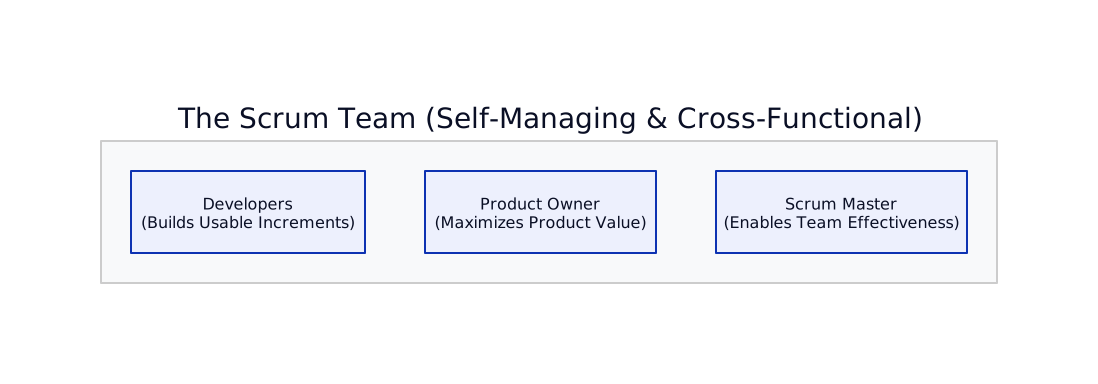
The Scrum Guide 2020 replaces the term “Roles” with Accountabilities to emphasize responsibility. A Scrum Team consists of three specific roles:
The Scrum Master: Supporting Teamwork and Responsibility
A Scrum Master (SM) is not a “Project Manager.” Instead, they support the team by: 1. Coaching Self-Management: Guiding Developers to decide who does what, when, and how, empowering them to take ownership. 2. Facilitating Collaboration: Ensuring all Scrum events are positive, productive, and kept within their timebox. 3. Removing Impediments: Shielding the team from external distractions and resolving organizational or technical blockers. 4. Fostering Agile Values: Cultivating trust and safety through the Scrum values of Commitment, Focus, Openness, Respect, and Courage.
How is a Scrum Master different from a Traditional Project Manager?
- Servant-Leader vs. Command-Control: A Project Manager assigns tasks and directs the team. A Scrum Master coaches and facilitates, allowing the team to self-organize.
- Process vs. Constraint Focus: A Project Manager manages constraints (budget, scope, schedule). A Scrum Master focuses on process health, team velocity, and removing blocks.
- Influence vs. Authority: A Project Manager has formal authority (e.g., hiring, evaluations). A Scrum Master has no direct management authority, influencing through trust and coaching.
3. The Scrum Process Flow (Slide 4 Diagram Explained)
The standard Scrum flow routes requirements from the initial idea down to a finished, usable piece of software. Let’s map out the four key components of the Scrum process diagram:

Let’s break down these four components exactly:
- Product Backlog: An ordered, dynamic list of everything needed in the product. It is managed by the Product Owner and serves as the single source of requirements.
- Sprint Planning: A collaborative event held at the start of the Sprint where the Scrum Team aligns on the Sprint Goal and selects items from the Product Backlog.
- Sprint Backlog: The set of selected Product Backlog items for the Sprint, plus a plan for delivering the Product Increment and realizing the Sprint Goal. It is managed exclusively by the Developers.
- Product Increment: A concrete step toward the Product Goal. Each Increment must be usable, meet the Definition of Done (DoD), and provide immediate value to stakeholders.
4. Empiricism: Driving Continuous Learning & Improvement
Scrum is built on empirical process control (Empiricism), which asserts that knowledge comes from experience and making decisions based on what is observed. Empiricism relies on Three Pillars:

These pillars are exercised through the five key Scrum events, which form structured feedback loops to ensure continuous learning and process improvement:
- Sprint Planning: Inspects the Product Backlog and adapts to establish the Sprint Goal and the Sprint Backlog.
- Daily Scrum: A 15-minute sync for Developers to inspect progress toward the Sprint Goal and adapt their plan for the next 24 hours.
- Sprint Review: A feedback loop with stakeholders to inspect the Increment, learn from market/user feedback, and adapt the Product Backlog.
- Sprint Retrospective: An internal session for the Scrum Team to inspect their relationships, processes, and tools, and adapt by planning actionable improvements for the next Sprint.
5. Living the Scrum Values
For Scrum to succeed, the team must practice the five Scrum Values defined in the 2020 Scrum Guide:
- Commitment: Committing to achieving the team’s
goals and supporting each other.
- Action: Taking ownership of your tasks and sticking to the sprint plan.
- Focus: Focus on the work of the Sprint and the
team’s goals.
- Action: Prioritizing the Sprint Goal and avoiding outside distractions.
- Openness: Being open about the work, challenges,
and roadblocks.
- Action: Flagging blockers early in the Daily Scrum instead of hiding them.
- Respect: Respecting each other to be capable,
independent people.
- Action: Listening to and valuing peer suggestions during retrospectives.
- Courage: Having the courage to do the right thing
and work on tough problems.
- Action: Saying “no” when the workload exceeds capacity, and raising concerns about unrealistic expectations.
By understanding how these accountabilities, events, artifacts, and values work together, you are well-equipped to practice Scrum effectively and ace your Agile assessments!